
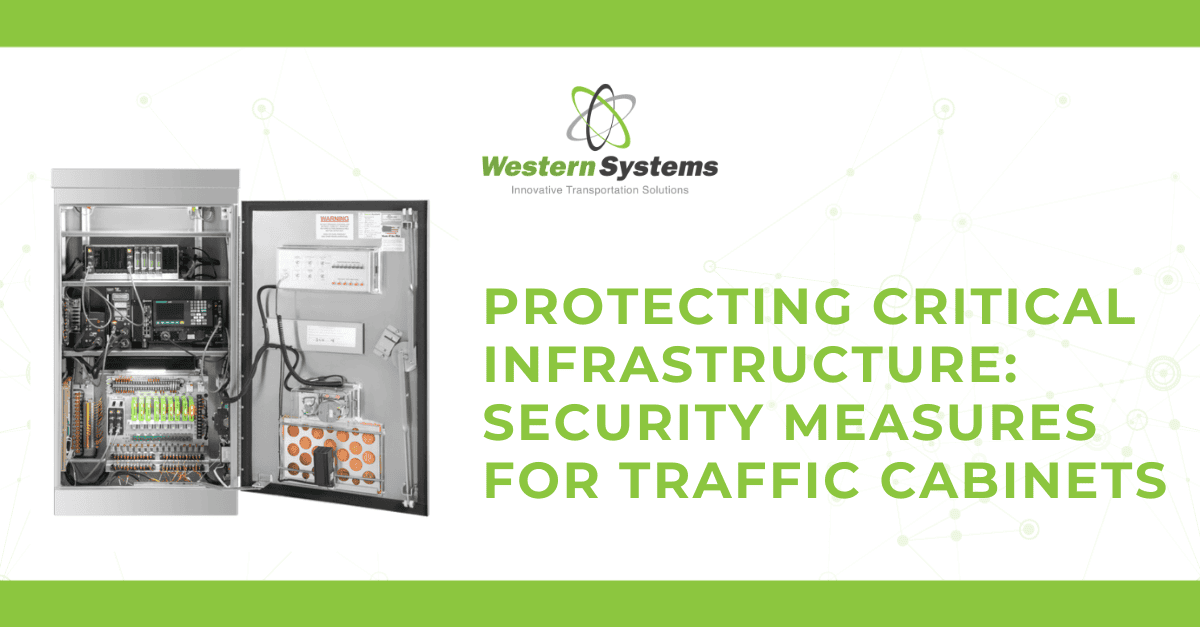
When a traffic cabinet is compromised, the result is often more than a service call; it can be a public-safety incident. Unsecured doors, cut cables, or tampered controllers can darken an intersection, trigger flash, or disable priority signals that emergency vehicles rely on. This guide outlines practical physical and cyber measures that agencies can implement now, and how Western Systems supports a complete hardening program, without forcing a costly rip-and-replace.

Why Cabinets are Targeted and How Failures Happen
- Easy Access & High Impact: Cabinets are placed at the curb and can control an entire intersection.
- Opportunistic Tampering: Loose locks, single-point latches, or missing fasteners can invite entry.
- Collateral Damage: Both vehicle strikes and weather exposure weaken hinges, seals, and wiring, all making later vandalism easier.
- Connectivity Risk: As more cabinets are networked, poor credential hygiene or flat networks can expand the breach’s impact.
Physical Security: Keep People Out, Keep Signals On
1) Harden The Enclosure
Start with the basics that physically prevent entry and deter tampering:
- Industrial-grade locks, three-point latching, reinforced hinges, and tamper-resistant fasteners will all harden the enclosure.
- Weather-sealed doors and 5052-H32 aluminum construction for prying resistance and corrosion.
- Interior compartmentalization (e.g., separating backup power & comms from the main bay) to limit the damage if a door is forced.
2) Control The Attack Surface
A cabinet that is easy to service is also easier to secure consistently:
- Clean cable routing with protected penetrations and drip loops to seal conduit entries.
- Labeled wiring and tidy terminations for the reduction of “panic fixes” that will leave doors ajar or panels unsecured.
- Consider aesthetic deterrents (e.g., city-approved wraps) to reduce graffiti and tampering while preserving cooling and service access.
3) Design for Quick Recovery
Even strong physical measures cannot prevent every incident. Recovery planning prevents a compromise from becoming an extended outage:
- Modular interiors are designed so technicians can replace a damaged module in minutes, restoring service.
- Spare capacity (shelves, power, I/O) to ensure emergency replacements don’t require field improvisation.
- Crash posts or strategic placements where cabinets are vulnerable to vehicles.
How Western Systems Traffic Cabinets Facilitate Security:
In-house, BABA-compliant cabinets are built for durability and maintainability. Reinforced doors, three-point latching, weatherproof construction, silk-screened wiring, and modular layouts help agencies align cabinet design with security policy and site constraints. Interior compartments and spare capacity can be tailored to isolate critical subsystems and support faster restoration after an incident.
Power Integrity: Prevent Dark Signals During Incidents
Physical attacks and storms often bring the same outcome: loss of power and unstable voltage. Resilience planning reduces the chance of dark signals or prolonged flash:
- Integrated battery backup within the main cabinet reduces exposed wiring and keeps signals operational during utility loss or after physical incidents.
- Proper grounding and surge protection guard against intentional or incidental surges that can potentially brick electronics.
- Generator bypass provisions allow safe, temporary power without opening the cabinet for extended time periods.
Cyber Hygiene at the Cabinet: Simple, Effective Controls
Cabinet security is no longer only about locks and hinges. As networking expands, basic cyber controls become part of cabinet hardening.
- Unique credentials & role-based access for both controllers and field devices (no shared logins).
- Network segmentation (VLANs) to isolate cabinet devices from the general city network.
- Secure remote access (VPN or equivalent), not open management ports.
- Least-privilege accounts for contractors; revoke at the end of the project.
- Change control for firmware/config updates; sustain a known-good baseline in the cabinet and at the TMC.
- Event logging & alerts (door open, config change, failed logins) are all tied to your central system.
Monitoring and Response: See Issues Before the Public Does
Security is strongest when agencies can detect, diagnose, and respond quickly:
- Door-ajar and intrusion switches are integrated with your ATMS alarm systems.
- Environmental sensors (temp/humidity) built to catch seal failures that invite corrosion and shorts.
- Power state alerts (utility vs. backup) and controller/monitor status codes for early triage.
- Playbooks for rapid response: who rolls, what to bring, how to restore safe indications first.

In addition, agencies can shorten response time by improving cabinet fault visibility at the intersection. A NEMA-compliant Malfunction Management Unit with dual LCD displays continuously monitors RYG(W) signal states and cabinet conditions in both TS-2 and legacy TS-1 environments. This real-time view, paired with time-stamped event history and true RMS voltage measurement, helps technicians determine whether an issue is a signal fault, an intermittent voltage condition, or a cabinet malfunction before it escalates into a prolonged flash event. For corridors using Flashing Yellow Arrow operations, this level of monitoring also supports clearer troubleshooting and post-incident review when incidents involve power disturbances or intrusion-related damage.
A Practical Cabinet-Hardening Checklist
- Reinforced doors, three-point latching, tamper-resistant hardware
- Door switches and alarm integration
- Sealed penetrations; inspected gaskets and vent screens
- Integrated backup power; surge/grounding audit
- Modular interiors; spare capacity for emergency swaps
- Baseline configs, firmware, and password policy
- Segmented networking; secure remote access
- Environmental, power, and door alerts with runbooks
- Crew training and periodic drill
- Annual security review covering physical and cyber controls
Start Where Risk is Highest
Prioritize school zones, emergency routes, and high-volume arterials. Western Systems can support a targeted assessment and a phased hardening plan, starting with lock and latch improvements and door alarm upgrades, followed by power and surge protection, and then monitoring and network policy alignment. The goal is practical resilience: fewer incidents, faster recoveries, and intersections that stay safe and consistent under stress.
Ready to harden your cabinets? Western Systems can help you assess, prioritize, and deploy upgrades that meet your standards and fit your budget. Contact us today to learn more.