- Solutions
- Products
- Blog
- Resources
- Partners
- About
- Contact

Case Study: Renton, WA, Uses Adaptive Signals To Manage Peak-Time Traffic
The City of Renton is expanding adaptive signal control on some of its busiest corridors so traffic signals can respond in real time to changing demand. By building on an existing Split Cycle Offset Optimization Technique (SCOOT) deployment, the city is focusing on peak-period performance, travel-time reliability, and more efficient use of existing roadway capacity.
Project Snapshot:
- Agency: City of Renton Public Works, Transportation Systems Division
- Location: Renton, Washington
- Project type: Adaptive signal control expansion
- Corridors:
- NE Third Street, Monterey Avenue NE to Sunset Boulevard
- Sunset Boulevard, NE Third Street to I-405 southbound on-ramp and Maple Valley Highway/Bronson Way
- Bronson Way/Maple Valley Highway, Factory Avenue N/Houser Way to Cedar River Park Drive
- Signals: 7 new adaptive signals, 34 total adaptive intersections after expansion
- Core technology: Yunex Traffic SCOOT adaptive signal control with all-in-one stop bar and advanced detection, distributed and supported regionally by Western Systems
Challenge: Peak-Hour Congestion on Key Corridors
Renton has seen increasing volumes on corridors connecting neighborhoods, downtown, and regional routes such as I-405. At many locations, traffic signals were still operating on fixed or time-of-day schedules that could not respond to shifts in traffic patterns due to incidents, weather, or changing commute habits. That meant queues could build up at one intersection while green time went unused at another.
The city had already implemented SCOOT on an earlier corridor and seen benefits, but wanted to extend those gains to additional locations where residents and businesses regularly experience peak-time delays. The goal was not just to move more cars, but to manage the system in a way that aligns with Renton’s broader approach to congestion management and corridor performance.
Objectives: Real-Time Operation and Better Use of Existing Capacity
For this expansion, Renton defined clear operational objectives:
- Improve travel time reliability on select corridors without widening roadways.
- Increase throughput during peak periods to allow more vehicles to pass through each corridor in the same amount of time.
- Support system uptime and reduce the need for constant manual retiming.
- Give engineering staff better visibility into how intersections perform throughout the day.
These objectives reflect a larger city strategy: use intelligent transportation systems to stretch the value of existing infrastructure before turning to more expensive capital projects.
Approach: Expanding SCOOT with Modern Detection
At its November 10 meeting, the Renton City Council approved adding adaptive signal control at seven additional intersections. The project converts signals that previously relied on pre-scheduled timing so they can participate in a fully adaptive network, as described in the original Renton Reporter coverage.
Each upgraded location receives all-in-one detection that covers both the stop bar and a distance upstream. This detection continuously measures flows and queues and feeds the data into the Yunex Traffic SCOOT adaptive control platform. SCOOT uses the live data to update splits, offsets, and cycle lengths in small increments so the coordinated system responds to actual demand across the full corridor rather than a static plan.
Western Systems supports the city as the regional distributor and integrator for Yunex Traffic SCOOT, providing hardware, configuration support, and operator training tailored to Renton’s network and staff needs.
Implementation: Targeted Corridors and Funded Program
The expansion focuses on three connected corridors where delays and variability are most noticeable to the public: NE Third Street, Sunset Boulevard, and Bronson Way/Maple Valley Highway. Treating these as coordinated corridors allows SCOOT to balance demand between intersections rather than optimizing each one in isolation.
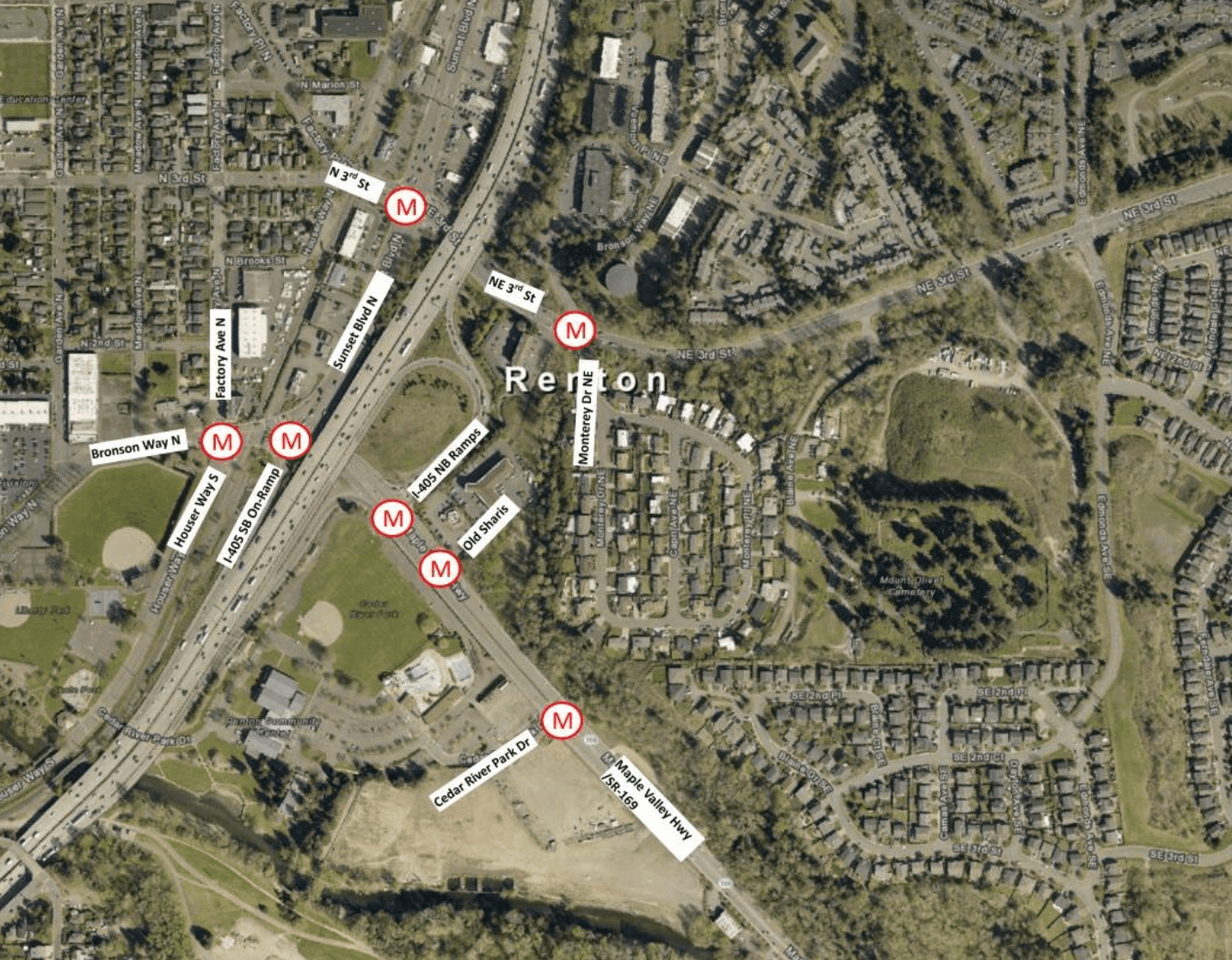
Photo Credits: https://www.rentonreporter.com/news/renton-to-upgrade-traffic-lights-to-adjust-for-peak-times/
The work is funded through the city’s Transportation Improvement Program, which includes an $846,000 budget line in 2025 to support adaptive signal control and related improvements. This programmatic funding approach helps Renton phase ITS investments strategically across multiple corridors over time.
Results: Documented Gains in Travel Time and Throughput
Before committing to the 2025 expansion, Renton evaluated how SCOOT performed on an earlier deployment between Oakesdale Avenue SW and 128th Avenue SE. A 2017–2018 study found:
- Average weekday travel time decreased by about 8 percent for westbound traffic and 13 percent for eastbound traffic along the corridor.
- During midday and afternoon peaks, travel times improved by roughly 3 to 12 percent.
- Even as morning traffic volumes rose between 2.9 and 19.6 percent, overall throughput increased by 6.5 percent in the morning, 0.8 percent at midday, and 3.3 percent in the afternoon.
The morning peak still saw modest increases in travel time due to higher demand, but the adaptive system enabled more vehicles to pass through the corridor on the same physical roadway, demonstrating that SCOOT can help cities manage growth pressures without immediately resorting to widening.
Building on SCOOT Results for Future Peak-Hour Planning
Renton’s experience shows that adaptive signal control can be a practical tool for cities seeking to improve peak-period operations while working within the constraints of existing streets. Key lessons include the value of:
- Pairing adaptive software with reliable, all-in-one detection hardware.
- Treating corridors as networks, not individual intersections.
- Using measured results to guide future phases and funding decisions.
Western Systems continues to support Renton with Yunex Traffic SCOOT adaptive control, training, and cabinet and system expertise, enabling the city to refine timing as patterns evolve. Agencies interested in how adaptive signal control can help manage peak traffic on their corridors can explore solutions and case studies at Western Systems, learn more about the Yunex Traffic SCOOT adaptive control platform, and connect with the team to discuss project goals and potential next steps.