
ITE Western District 2026 will bring together transportation professionals working on some of the industry’s most immediate challenges, from intersection safety to climate resiliency to signal system performance. For Western Systems, this year’s program is a chance to contribute to those conversations in a focused, practical way through sessions grounded in field experience, agency priorities, and day-to-day operations.
1. AI Detection and Intersection Reliability
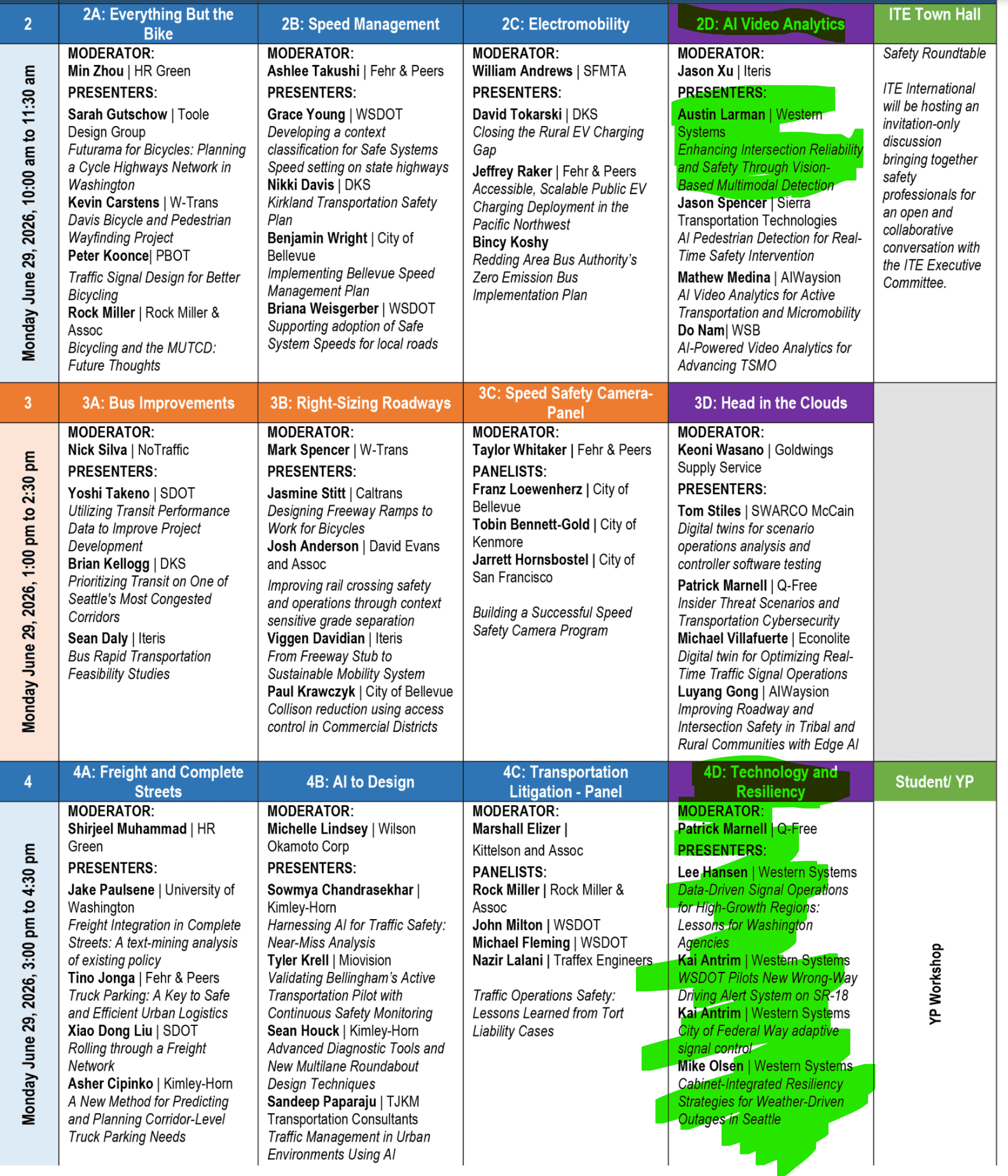
Austin Larman will present during the 2D: AI Video Analytics session on Monday, June 29, from 10:00 a.m. to 11:30 a.m. His presentation, “Enhancing Intersection Reliability and Safety Through Vision-Based Multimodal Detection,” points directly to an issue many agencies are working through right now: how to improve detection performance for vehicles, pedestrians, and other users while supporting safer, more reliable intersection operations.
That topic fits Austin’s background. His resume highlights more than 20 years of experience in the traffic and electrical fields, including new installations, training, diagnostics, and support for signal equipment and ITS deployments. That hands-on experience matters because agencies are not just looking for new tools. They are looking for practical ways to improve reliability in the field and reduce the gaps that show up in daily operations.
2. Data-Driven Signal Operations
Later that day, during the 4D: Technology and Resiliency session from 3:00 p.m. to 4:30 p.m., Lee Hansen is scheduled to present “Data-Driven Signal Operations for High-Growth Regions: Lessons for Washington Agencies.” The session title alone signals a useful focus: not theory, but how agencies can use data to manage traffic operations more effectively as demands increase across growing communities.
Supporting material for this topic describes a performance-based approach to traffic management that uses high-resolution controller data, alarm monitoring, and corridor-level analytics to identify issues such as split failures, coordination drift, pedestrian delay, and recurring field malfunctions. The goal is straightforward: help agencies shorten troubleshooting time, reduce technician callouts, and move from reactive work toward more proactive operations. Lee’s experience in traffic engineering, operations, signal deployment, and connected vehicle projects makes him a strong fit for that discussion.
3. Wrong-Way Driving on SR-18
Kai Antrim is listed in the 4D: Technology and Resiliency session with “WSDOT Pilots New Wrong-Way Driving Alert System on SR-18.” This presentation is especially relevant for transportation professionals focused on safety, TSMO, and corridor management. The abstract describes a multilayer pilot system on four SR-18 off-ramps in King County that combines solar-powered LED signs, radar-triggered activation, and dual-camera analytics to identify and respond to wrong-way entries.
What makes this session valuable is its operational framing. It is not just about device placement or system architecture. It also addresses how alerts are escalated, how operators are notified in real time, and how agencies can coordinate response with state patrol and local partners. For attendees seeking practical insight into proactive safety strategies, this is likely to be one of the more concrete resilience and operations sessions on the schedule. Kai’s profile notes years of experience supporting agencies, consultants, and contractors across the ITS industry, with an emphasis on traffic signal products, technical support, and stakeholder-specific training.
4. Adaptive Signal Control in Federal Way
Kai Antrim is also listed with a presentation on the City of Federal Way adaptive signal control during that same resiliency session. Even without a separate abstract, the topic stands out because adaptive operations remain a practical area of interest for agencies seeking to improve corridor performance, travel-time reliability, and day-to-day signal coordination without overcomplicating field maintenance.
For many attendees, this session will likely resonate because adaptive signal control is no longer a future-facing concept. It is an active operational question. Agencies want to know what works, what takes sustained support, and how to connect system performance back to the needs of drivers, transit, technicians, and corridor managers.
5. Resiliency for Weather-Driven Outages
The final Western Systems-related presentation in the 4D session is Mike Olsen’s “Cabinet-Integrated Resiliency Strategies for Weather-Driven Outages in Seattle.” Additional session material provided for this topic explains that the presentation will explore how the City of Seattle identified vulnerable intersections during wind-driven outages and used cabinet design, backup power integration, and layout efficiency to improve reliability and support safer maintenance access during storms.
This session should be especially relevant for agencies dealing with more frequent outages, difficult field conditions, and the need to maintain signal uptime during disruptive weather. The abstract keeps the focus where it should be: on operational continuity, technician safety, and clear design choices that other agencies can evaluate for their own systems.
Why These Sessions Matter
Taken together, these presentations show a clear pattern. Western Systems’ participation at ITE Western District 2026 is centered on issues agencies are actively managing now: multimodal detection, signal reliability, proactive safety, data-driven operations, adaptive control, and weather-related resiliency. That gives attendees more than a list of technical presentations. It gives them access to discussions rooted in field conditions, public agency needs, and practical transportation outcomes.

See You at ITE Western District 2026
Ready to make the most of ITE Western District 2026? Register for the event through the Western ITE Annual Meeting page, then connect with Western Systems at the event to continue the conversation on signal operations, safety, and resiliency topics featured in this year’s program.