

Every August and September, the transportation environment around schools changes almost overnight.
School buses return. Parent drop-off queues grow. Students are walking, biking, and crossing streets during the same morning window when commuters are trying to get to work. Drivers who spent the summer traveling through relatively quiet school zones suddenly encounter a very different operating environment.
For traffic engineers, back-to-school season raises a bigger question:
Are drivers simply being told to slow down, or is the roadway environment helping them slow down?
Today’s school-zone safety conversation increasingly centers on Safe Routes to School, Vision Zero, speed management, vulnerable road users, and layered countermeasures rather than relying on a single sign or device.
The objective is not simply to add more signs. It is to create a school zone that drivers recognize, understand, and respond to.
WHERE TO START?
Start With the Safe Routes to School Framework. A school-zone project is rarely just a signing project. Safe Routes to School programs use a broader framework commonly organized around the 6 E’s:
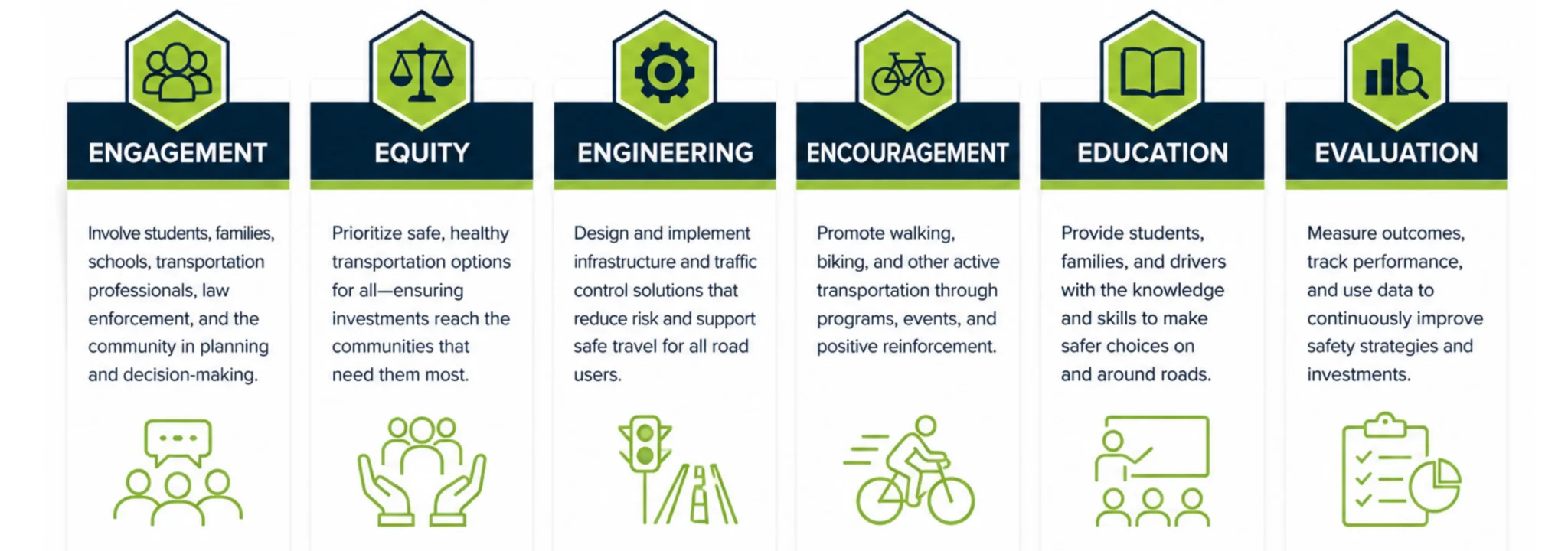
This framework is reflected in the school-zone planning approach outlined in Carmanah’s Safe Routes to School materials.
For transportation agencies, Engineering and Evaluation are especially important when selecting countermeasures.
Where are students actually crossing? Where are vehicle speeds highest? Are drivers failing to recognize the school zone, or recognizing it but failing to comply? Is the issue speed, yielding, visibility, or a combination of factors?
Those questions should drive treatment selection.
Discuss your need for an upcoming project with our Experts.
ONE SCHOOL ZONE, DIFFERENT SAFETY PROBLEMS
Not every school-zone problem is a speed problem. If drivers are not noticing when a reduced speed limit is active, the issue may be awareness. If drivers recognize the school zone but continue entering too fast, the issue may be speed compliance. If pedestrians are having difficulty crossing at an uncontrolled location, the issue may be yielding and crossing visibility. If an existing warning sign gets lost in visual clutter, the issue may be conspicuity. And some locations have several of these challenges at once.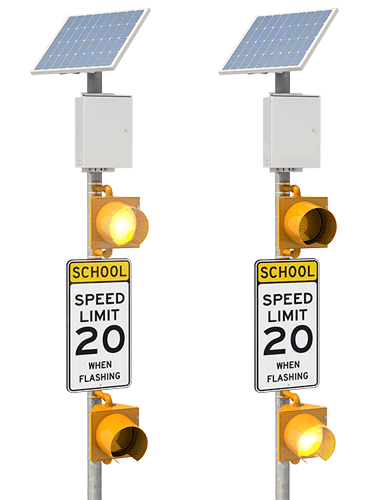
That is why a comprehensive school-zone strategy often works better as a layered system of countermeasures, with each treatment addressing a specific behavior or conflict.
SCHOOL-ZONE BEACONS REINFORCE WHEN REDUCED SPEEDS APPLY
Flashing school-zone beacons remains one of the most direct ways to reinforce when a reduced school speed limit is in effect. Instead of asking drivers to interpret the same static roadside environment throughout the day, scheduled flashing provides an active visual cue that conditions have changed.
That can be particularly useful in higher-volume corridors, locations with competing visual information, and school zones where reduced speeds apply only during specific arrival and dismissal periods.
Carmanah’s R829-MX school-zone systems can be scheduled and managed locally or remotely. The connected system also provides status information and configurable alerts, giving agencies greater visibility into whether deployed systems are operating as intended.
The value of connectivity here is practical.
School-zone treatment is only useful if it is operating when students are arriving and leaving.
For agencies evaluating a new installation, Carmanah also provides an interactive tool to configure a system based on the application.
Build an MX School Zone System
RADAR SPEED FEEDBACK GIVES DRIVERS SOMETHING STATIC SIGNS CANNOT
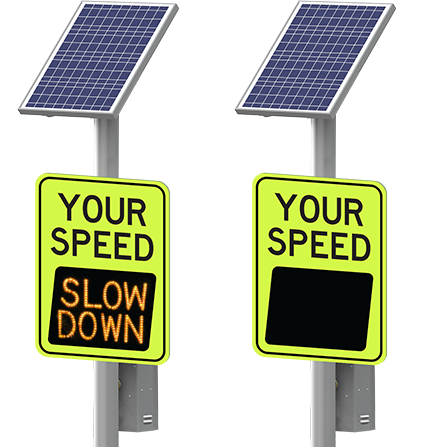 Sometimes the driver knows the speed limit and still needs another cue. Radar speed feedback creates immediate interaction with the approaching driver. A static speed limit sign tells everyone the same thing. A radar speed display tells one driver:
YOUR SPEED: 25
That feedback gives the driver an opportunity to self-correct before reaching the highest-conflict portion of the school zone.
Carmanah cites a school-zone study in which the percentage of vehicles exceeding a 20 mph school-zone speed limit decreased from 95.3% before radar speed signs were installed to 34.1% afterward.
But there is another reason radar feedback is becoming increasingly relevant to agencies: data.
Connected radar speedcheck signs can support the evaluation side of speed management. Instead of ending the project when the sign is installed, agencies can examine vehicle speeds and determine whether behavior actually changed.
That leads to better engineering questions: Did speeds decrease? When is speeding most prevalent?
Are conditions different during arrival and dismissal?
Is another countermeasure needed downstream?
This shifts from simply deploying a device to data-informed speed management.
LED-ENHANCED WARNING SIGNS ADDRESS CONSPICUITY
 School environments can contain a remarkable amount of visual competition.
Parked vehicles. Landscaping. Utility infrastructure. Buses. Parent queues. Commercial signage. Pedestrians. Bikes. Multiple traffic-control devices.
In that environment, simply having the correct sign in place does not necessarily mean it is receiving the necessary driver attention.
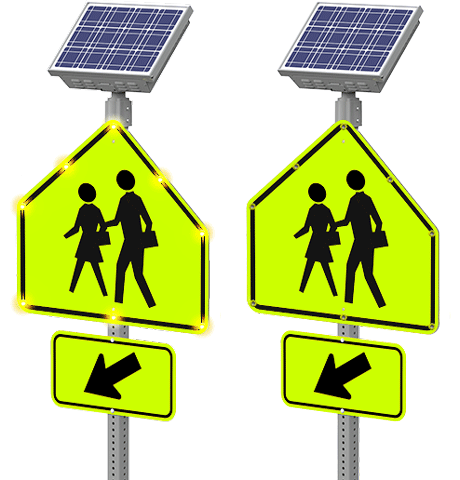
LED-enhanced signs and flashing warning systems can add active conspicuity to an existing regulatory or warning message.
Carmanah’s MX portfolio includes connected warning systems that can operate in several modes depending on the application, including continuously, through vehicle activation, or dusk-to-dawn.
The engineering principle is straightforward:
Use the countermeasure that matches the failure mode.
If the primary issue is that drivers are not recognizing a critical warning soon enough, increasing conspicuity may be more appropriate than simply adding another static sign.
Build an MX Stop or Warning System
AT CROSSINGS, FOCUS ON THE PEDESTRIAN CONFLICT
School-zone speed treatment and pedestrian crossing treatment are not interchangeable.
Where the primary issue is pedestrians crossing at an uncontrolled location, the engineering response needs to address the crossing itself.
Rectangular Rapid Flashing Beacons, or RRFBs, are one countermeasure available for appropriate uncontrolled marked crosswalk applications. Under the 11th Edition of the MUTCD, RRFB requirements and guidance are addressed in Chapter 4L.
Carmanah reports driver yielding rates of approximately 82 to 93 percent for RRFB applications and identifies school zones as one of the environments where the treatment has been deployed. This is also where a layered approach becomes particularly useful.
Learn how to apply new technology, stay MUTCD-compliant, and identify available funding opportunities for safer school zones. Watch the free webinar and earn 1 PDH.
WHAT DOESN’T WORK? TREATING EVERY PROBLEM THE SAME WAY
A school-zone safety program can have multiple countermeasures and still miss the underlying problem if treatments are selected without first understanding driver and pedestrian behavior.
- More signs do not automatically mean more compliance.
- More flashing does not automatically mean better treatment.
- And technology should not replace engineering judgment.
- Instead, start with the behavior or conflict that needs to change.
Drivers do not recognize the active school zone?
Consider improving the visibility and clarity of the active speed restriction.
Drivers recognize it but continue entering too fast?
Speed feedback may provide the additional cue needed for self-correction.
Drivers are not yielding at an uncontrolled pedestrian crossing?
Evaluate crossing-specific countermeasures.
A critical warning is getting lost in the roadside environment?
Consider whether enhanced conspicuity is appropriate.
The agency does not know whether the treatment worked?
Build evaluation into the project from the beginning.
INSTALLATION SHOULD NOT BE THE FINISH LINE
One of the most useful ideas in the 6 E’s framework is also one of the simplest: Evaluation.
If speed was the problem, measure speed.
If yielding was the problem, evaluate yielding.
If visibility was the problem, determine whether driver behavior changed after the treatment.
Remote Scheduling for School Beacons:
EXPLORE SCHOOL ZONE SOLUTIONS | TALK WITH OUR TEAM
Build your MX School Zone System