
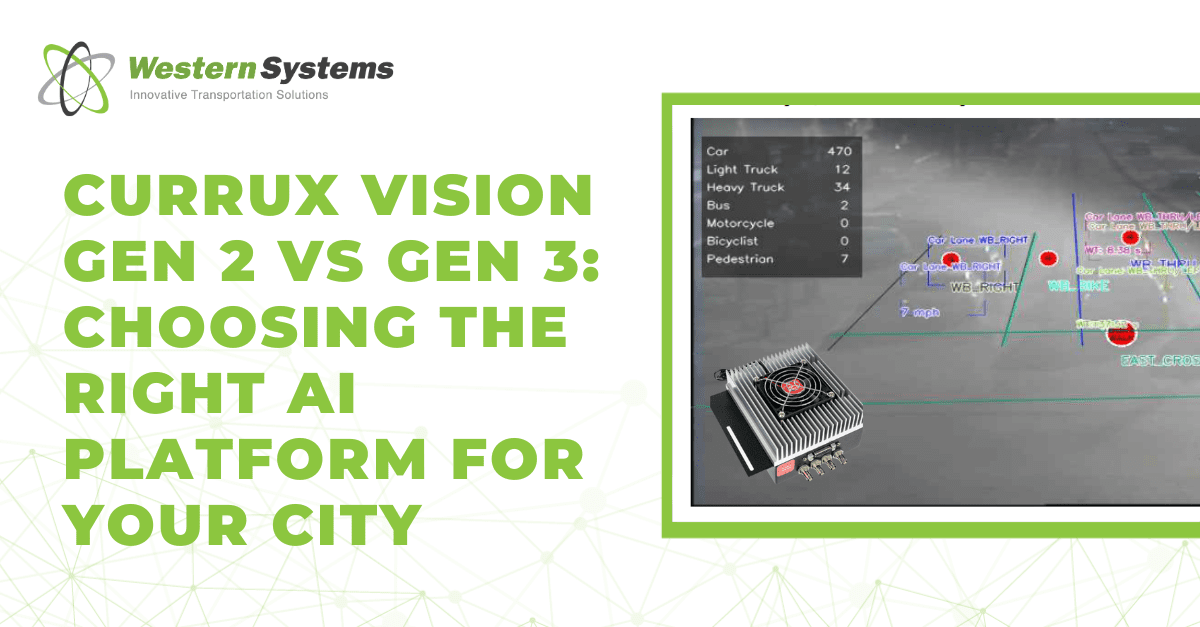
In today’s evolving traffic landscape, AI-based systems play a crucial role in helping public agencies reduce congestion, improve pedestrian and cyclist safety, and allocate resources more efficiently. As cities invest in smarter infrastructure, many agencies have asked: What’s the difference between Currux Vision Gen 2 and Gen 3?
This blog offers a clear, straightforward comparison to help decision-makers choose the right AI solution based on site needs and community priorities.
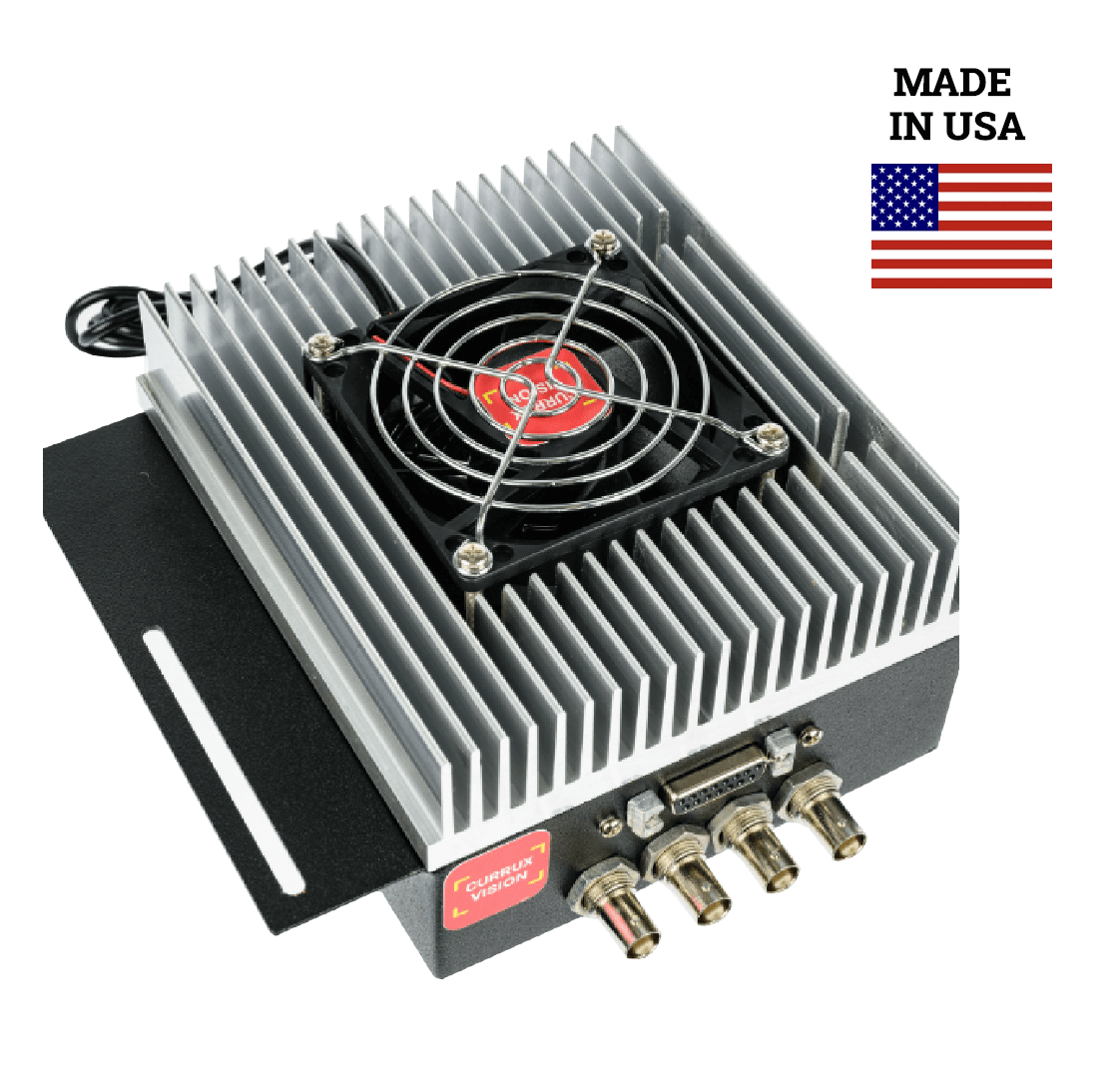
Proven Reliability for Everyday Intersections
Gen 2 has earned its reputation as a dependable workhorse. With a 512-core GPU and support for up to four simultaneous video streams, it delivers consistent AI-driven detection of vehicles, pedestrians, and bicycles. This makes it a trusted option for small to medium intersections, corridors with steady but not overwhelming volumes, and regions with variable but manageable weather. Agencies value its predictable uptime, straightforward integration into existing infrastructure, and ability to support urban planning without constant field intervention.
Power and Precision for Complex Environments
Gen 3 was built for scale. With a 2048-core GPU, 12-core CPU, and capacity for six video streams, it is nearly three times more powerful than Gen 2. That additional horsepower directly improves detection accuracy and classification, particularly in multimodal corridors where pedestrians, cyclists, micromobility users, and vehicles share space. For complex intersections with fluctuating demand, Gen 3 gives engineers the tools to allocate resources more effectively, anticipate congestion points, and apply predictive analytics that support public service goals.
Weather Conditions and Legacy Infrastructure

Not every agency operates with modern cameras or clear skies. Gen 3’s advanced AI model is specifically trained to handle poor visibility, harsh weather conditions like fog and snow, and degraded legacy video feeds. This enables cities to extract value from existing infrastructure while still improving accuracy. By reducing false negatives and maintaining reliable detection even in low light, Gen 3 minimizes unnecessary field calls, freeing human resources for higher-priority work and improving overall system uptime.

Detection and Classification Beyond Vehicles
While Gen 2 provides reliable detection of cars, pedestrians, and bikes, Gen 3 expands the scope. It supports advanced object classification, distinguishing between vulnerable road users, vehicle types, and even micro-mobility devices. For agencies prioritizing pedestrian and bicycle safety, this level of detail supports stronger urban planning decisions, safer corridor designs, and more precise signal coordination across active transportation networks.

Safety Analytics and Real-Time Notifications
Agencies are increasingly looking beyond traffic counts to deeper safety insights. Gen 3 enables advanced analytics, including near-miss reporting and real-time notifications (RTN) for new deployments. These capabilities give transportation departments better visibility into corridor performance and help coordinate with law enforcement and emergency services. By applying AI systems proactively, cities can shift from reactive maintenance and incident response to preventive safety strategies that reduce congestion and enhance community trust.
Matching Technology to Community Scale
The decision between Gen 2 and Gen 3 comes down to mission and scale. Smaller cities managing stable intersections may find Gen 2’s reliability more than sufficient. Larger metropolitan areas, especially those pursuing AI in local government initiatives, will benefit from Gen 3’s advanced classification, predictive analytics, and ability to thrive in complex or degraded environments. Both platforms align with broader smart city strategies, from traffic management to waste management and emergency services, helping agencies allocate resources efficiently and reliably.
Long-Term Value Through Collaboration
Western Systems works closely with agencies to align deployments with community outcomes. For some, that means reducing field maintenance calls through the proven reliability of Gen 2. For others, it means enabling advanced multimodal safety analytics through Gen 3. In both cases, the goal remains the same: public service, continuity of operations, and better outcomes for residents and commuters.
| Feature | Gen 2 (Proven Workhorse) | Gen 3 (3x More Powerful) |
|---|---|---|
| Processing Power | 512-core GPU, 8-core CPU, 4 video streams. | 2048-core GPU, 12-core CPU, 6 video streams. |
| Best Fit | Small to medium intersections, standard traffic volumes. | Large to super-large intersections, multimodal corridors. |
| Weather & Visibility | Performs reliably in variable but manageable weather. | Optimized for fog, snow, low light, and degraded legacy video. |
| Detection | Vehicles, pedestrians, bicycles | Expanded classification: vulnerable road users, micromobility, vehicle types. |
| Analytics | Solid detection and traffic data | Predictive analytics, near-miss reporting, and real-time notifications (RTN). |
| Staff & Resources | Proven uptime reduces maintenance needs. | Minimizes field calls, supports proactive safety, and maximizes limited human resources. |
| Community Impact | Reliable day-to-day operations support stable corridors. | Proactive safety management supports AI in local government initiatives and is future-ready. |
FAQs
1. What’s the most significant difference between Gen 2 and Gen 3?
Gen 2 is a stable, field-proven platform for standard intersections. Gen 3 is nearly three times more powerful and suited for advanced detection, predictive analytics, and harsh weather.
2. Do both systems use artificial intelligence (AI)?
Yes. Both apply AI-driven detection, but Gen 3 uses a third-generation AI model for higher accuracy, proactive safety analytics, and real-time notifications.
3. Which system reduces congestion most effectively?
For typical intersections, Gen 2 stabilizes traffic flow and reduces downtime. For high-volume, multimodal corridors, Gen 3 applies deeper analytics and predictive models to reduce congestion more effectively.
4. Can agencies use existing video infrastructure?
Yes. Gen 3 is optimized for poor-quality or legacy video feeds, helping agencies extend the life of existing equipment.
5. How do these platforms support broader community goals?
Both strengthen public trust by improving reliability and safety. Gen 2 focuses on proven performance and stability. At the same time, Gen 3 provides advanced data and analytics to support urban planning, multimodal safety, emergency services, and law enforcement.
Making the Right Choice for Your Intersections
Both Currux Vision Gen 2 and Gen 3 deliver meaningful benefits for agencies, but their strengths are distinct. Gen 2 offers proven reliability for everyday operations, while Gen 3 opens the door to advanced detection, predictive analytics, and real-time safety insights at larger and more complex intersections. Agencies should weigh their intersection scale, infrastructure condition, and long-term goals before deciding.
Learn more about how Currux Vision supports smarter traffic planning and operations:
To explore how these AI-powered platforms can support your city’s transportation initiatives, contact Western Systems to speak with your territory manager today.